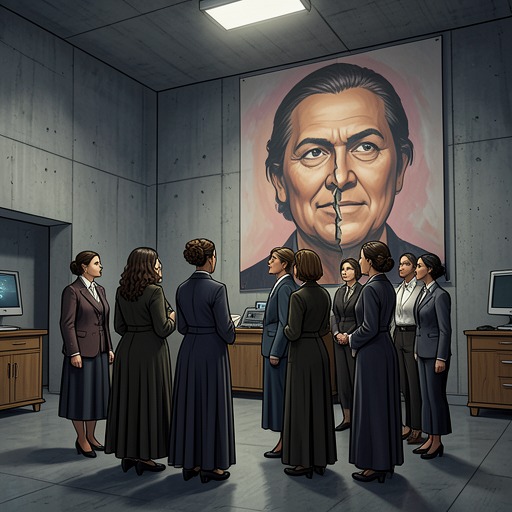
Women's political disenfranchisement
Night and DayWomen's political disenfranchisement is the political condition that gives Mary Datchet’s work its purpose and urgency, while exposing the distance between women’s commitment to public life and their exclusion from electoral power. Through the suffrage office and its campaigners, the novel depicts political inequality as a daily organizing problem, a contested cause, and a constraint on women’s recognized choices—not merely as an issue raised in conversation.
Political Exclusion and Everyday Work
The absence of women’s votes is expressed plainly in a conversation about men’s habitual discussion of politics. Mary wonders whether women would talk about politics too if they had votes; when Katharine observes that Mary spends her life getting them votes, Mary replies that she works at it from ten until six every day. The exchange links political exclusion directly to labor: what women cannot yet do as electors, Mary tries to change through sustained work on behalf of the cause.
That work takes place within the ordinary machinery of an office. Mary’s society for women’s suffrage occupies the top floor of a large house in Russell Square, subdivided among organizations whose typewriters click throughout the working day. Mary arrives to compete with the other offices’ activity, then turns to letters and the practical demands of her work. The setting makes advocacy part of a shared world of clerical labor, while marking the suffrage society as one organization among many seeking to shape public affairs.
The society’s limited resources make its campaign concrete. Mary is responsible for arranging a series of entertainments whose profits are meant to support an organization that is flagging for lack of funds. It is her first attempt at large-scale organization, and she imagines using the events to draw notable people into a pattern that will attract Cabinet Ministers’ attention; once their interest is caught, the society can present its arguments afresh. The ambition is substantial, but its means are painstaking: correspondence, planning, and the effort to convert public attention into political influence.
The Society and Its Disagreements
Mary’s commitment does not make the society’s members interchangeable. Mrs. Seal describes her history of committee work and says she has abandoned other philanthropic and civic duties for the suffrage cause, which she regards as fundamental. For her, women’s votes are bound up with the welfare of women and with humanity more broadly. Her assurance that the cause can claim a lifetime of service sets its work across generations: her father was a pioneer, she has continued after him, and she looks to younger women to carry it forward.
Mary’s response to this rhetoric is more complicated than simple agreement. When Mrs. Seal insists that anyone concerned for women must want them to have the vote, Katharine protests that she never said she opposed suffrage. Yet when asked why she is not a member of the society, she offers no immediate answer. Later, she tells her father that she would not work with the campaigners, despite making clear that this refusal is not a declaration against women’s votes. The distinction matters: the novel separates support for the principle from willingness to join a particular organization, and shows how proximity to fellow advocates can make a cause’s practical character more visible than its ideals at a distance.
Mr. Hilbery gives that discomfort a broader interpretation. He observes that agreement with one’s fellow enthusiasts can expose a cause’s faults more sharply than opposition does, and recalls that contact with his own political allies once weakened his enthusiasm for a public meeting. His account helps explain why Katharine may sympathize with a political aim yet feel alienated by its advocates; it does not erase the difference between her position and Mary’s sustained work. In this household, public commitment is considered and judged, but the discussion also reveals how easily a movement can be reduced to the conduct of its members.
Women’s Work and the Limits of Recognition
Mary’s campaigning belongs to a larger pattern of women’s labor that is necessary but poorly recognized. Elsewhere, Katharine is made responsible from childhood for household affairs: ordering meals, directing servants, paying bills, and keeping the home running. The narrator describes her domestic competence as a profession without a title and with little recognition. That framing gives the suffrage office a revealing counterpart. Both household management and political organizing depend on women’s sustained work, but the value and standing of that work are not automatically acknowledged.
The distinction is especially sharp in Mary’s case because she is an amateur worker whose services are unpaid. She imagines herself among the city’s workers and organizes her day around office duties, yet her society’s efforts have so far met little public appetite for the benefits it offers. Her work is therefore doubly constrained: women lack the vote, and the labor intended to alter that condition does not itself secure Mary a paid position or guarantee political influence. The narrative recognizes her purpose and discipline without pretending that effort alone overcomes the conditions she confronts.
The movement’s public cause also coexists with the private choices and conventions that shape women’s lives. When Katharine faces questions about her relationships and conduct, she finds that traditional rules for an unmarried woman are readily available, but that they do not answer what she herself feels. The passage does not equate these intimate dilemmas with the denial of political rights. Instead, it places the two within a wider picture of limited authority: received rules may prescribe women’s conduct, while political institutions exclude them from the vote. Katharine’s effort to use her own sense of truth as a guide contrasts with the collective labor through which Mary seeks to change public arrangements.
Parliamentary Setback and Continued Campaigning
The political constraint becomes unmistakable when women’s votes again slip beyond reach through a parliamentary maneuver. Mrs. Seal reacts with anger and dismay, reading the defeat as an insult to women and a blow to her life’s work. Looking toward the passers-by and omnibuses in Russell Square, she distinguishes ordinary people, in whom she continues to believe, from the political leaders whom she blames for withholding justice. Her response reveals both the scale of her disappointment and the persistence of her faith that the public might be persuaded if the case could be put before it directly.
Mr. Clacton treats the reversal less as a final defeat than as a familiar setback in political campaigning. He argues that reverses have occurred in other important campaigns and turns at once toward revising the society’s methods. The proposed response is administrative and methodical: reorganize the card index, issue new leaflets, and use a map of England to classify suffrage organizations by district, with documents filed for reference. He imagines the society as a telephone exchange for ideas, connecting its central office to communities across the country and learning what people think so that it can influence them. The image makes the campaign’s work look less like a single appeal than an extensive system for collecting, ordering, and circulating political information.
Mrs. Seal, meanwhile, presents the cause as work that will outlast any one campaigner. Her confidence that each generation must take another’s place meets the immediate disappointment of the parliamentary setback, but refuses to treat defeat as closure. The office’s differing responses—her moral indignation and Mr. Clacton’s organizational recalculation—show two complementary ways of sustaining a movement: insistence on the justice of its aim and adaptation of the means used to pursue it.
Significance
Women’s political disenfranchisement structures the contrast between possessing a political claim and possessing political power. Mary can devote her working day to securing votes for women, but she cannot herself exercise the electoral rights she seeks; the society must instead rely on organization, fundraising, publicity, and persuasion. The eventual parliamentary setback confirms that dedicated labor does not control the institutions it addresses.
At the same time, the novel resists treating the campaign as a simple divide between committed reformers and indifferent opponents. Mary works with determination, Mrs. Seal invests the cause with a generational and humanitarian mission, Mr. Clacton devises systems for renewed campaigning, and Katharine’s hesitation demonstrates that sympathy need not entail membership. By placing these distinct responses within the same political condition, the narrative presents women’s exclusion as both a shared structural fact and a pressure that produces divergent forms of work, belief, and judgment.